

Accelerating State Highway Renewal at Scale
Funded by the Government’s $2.07 billion Pothole Prevention Fund, the Tīrau to Waiouru (T2W) project is one of New Zealand’s largest and most ambitious State Highway 1 maintenance programmes.
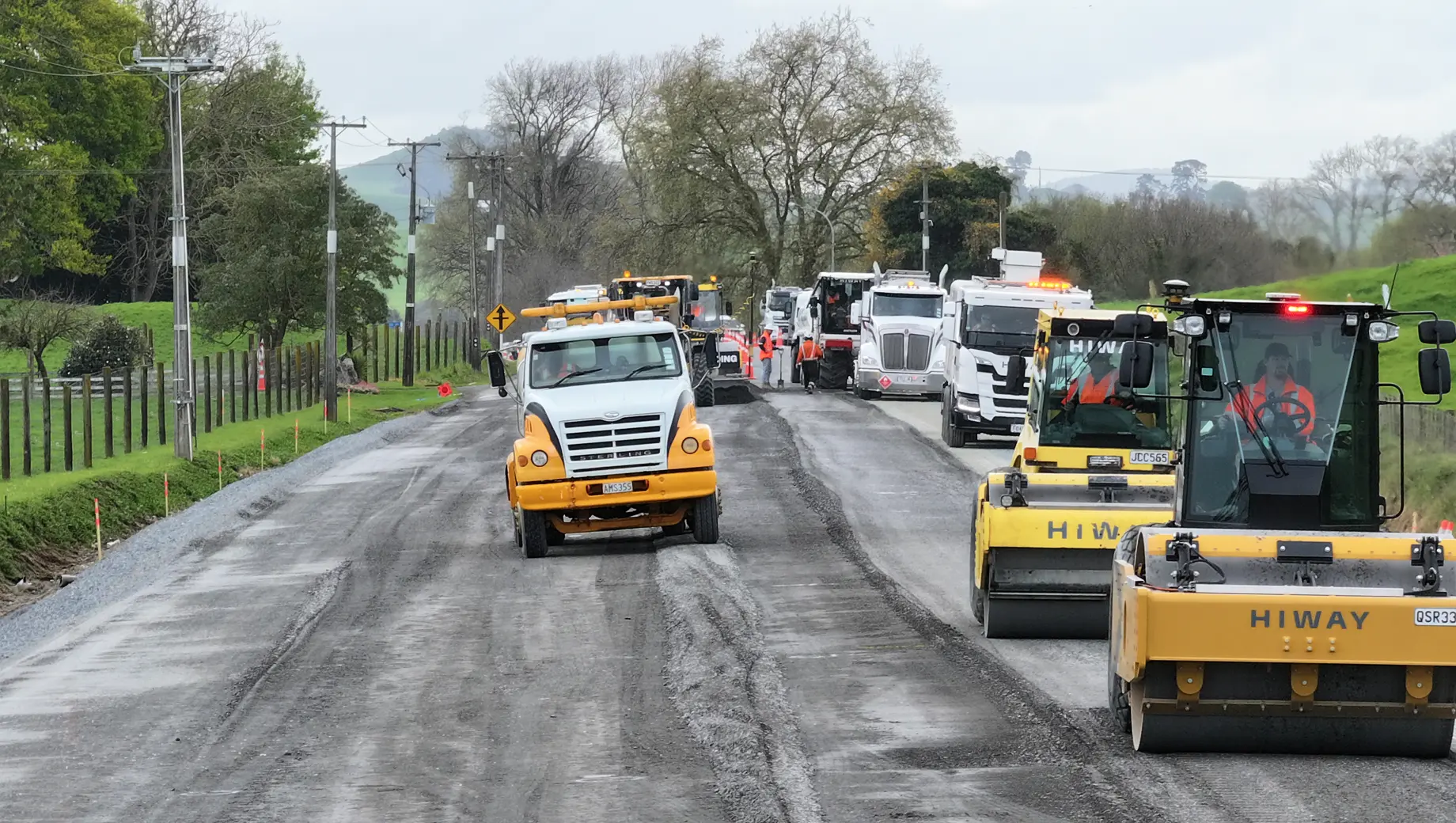
Valued at $150 million, the accelerated programme delivered intensive pavement rehabilitation and resurfacing works across the central North Island using an innovative full road closure methodology to improve quality and reduce disruption.
Accelerated Delivery Approach
In a significant shift from traditional highway maintenance, T2W utilised full road closures to condense four seasons of maintenance into just two. This approach enabled safer working environments, reduced traffic impacts, and significantly improved construction quality by minimising rework. Limiting traffic through active worksites also supported better compliance with long‑life pavement design outcomes.
Scope of Works
The project consisted of eight delivery zones, with up to 12 sites per zone, and site areas ranging from 900m² to 44,000m². Pavement treatments included:
- Foam bitumen stabilisation (316,800m²)
- Structural asphalt (127,000m²)
- Thin asphalt surfacing (465,300m²)
- Chipseal (218,900m²)
- Stellar Projects’ Role – MSQA and Contract Administration
Stellar Projects was engaged to provide Contract Administration and MSQA (Management Systems Quality Assurance) services across multiple contractors and regions. Our team led rigorous quality assurance and monitoring activities to ensure works were delivered in accordance with NZTA specifications and 25‑year pavement design requirements.
This included close coordination with designers, independent technical reviewers, NZTA’s Principal Project Manager, and Subject Matter Experts. Responsibilities also covered traffic management and safety performance monitoring, design and scope change management, practical completion inspections, and defect liability close‑out.
Quality, Scale and Performance
At peak delivery, Stellar Projects’ MSQA team was overseeing works valued at up to $18 million per month, providing assurance across granular overlays, cement and foam bitumen stabilisation, deep‑lift structural asphalt, sealing works, and asphalt wearing courses. Our in‑depth technical knowledge ensured all contractor submissions met compliance requirements and supported consistent, high‑quality outcomes across the programme.
Case Study - Tīrau to Waiouru Rehabilitation Accelerated Programme (TWRAP)
Stellar Projects, in partnership with Waka Kotahi NZ Transport Agency (NZTA) and Downer, developed this case study to examine a new approach to pavement rehabilitation delivery across New Zealand’s state highway network. The study compares the Tīrau to Waiouru Rehabilitation Accelerated Programme (TWRAP) with the traditional business‑as‑usual (BAU) Network Outcome Contract (NOC) model, assessing performance across cost efficiency, safety, construction quality, and long‑term network value.
The primary objective of TWRAP was to deliver a stronger, more durable roading network—one that is less prone to potholes, requires fewer future interventions, and minimises disruption to motorists and freight operators. Under the BAU model, pavement rehabilitation is typically delivered using stop/go traffic management, allowing vehicles to pass through partially completed worksites. On high‑volume state highways, this approach can expose both road workers and road users to elevated safety risks, while also reducing productivity and construction quality due to constrained working space, traffic damage, and weather exposure during peak construction periods.
By contrast, the accelerated delivery model adopted under TWRAP sought to improve safety outcomes, increase construction efficiency, and achieve better long‑term pavement performance, supporting a more resilient and reliable state highway network for New Zealand.


