

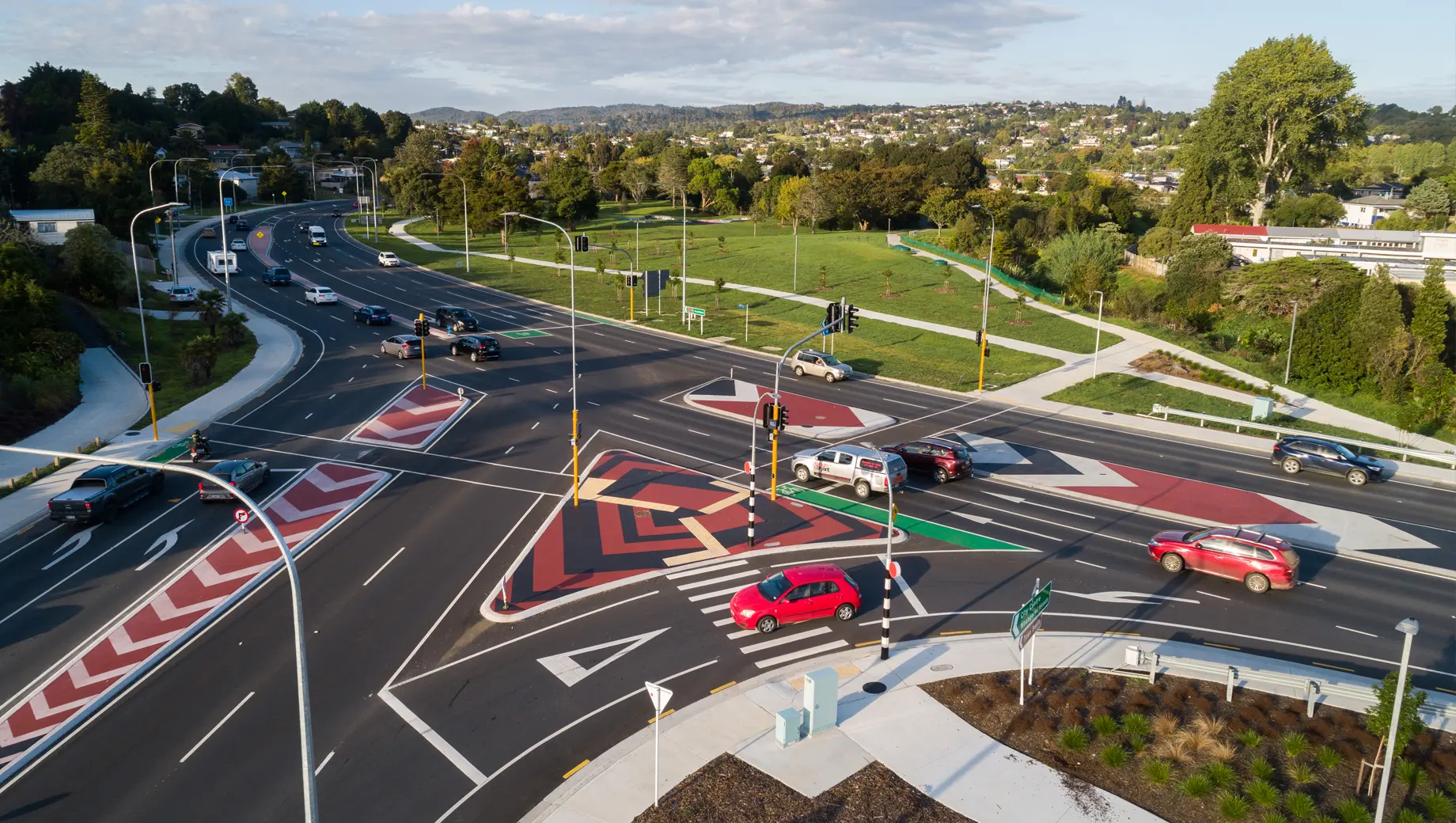

This complex civil project was delivered within a densely populated and urban environment on SH1 through central Whangārei.
The project faced significant physical site constraints, necessitating the undergrounding of extensive overhead high-voltage power, the relocation of telecommunications cables, high-pressure and low-pressure gas mains, and fibre optic cables, as part of the contract works. The project was completed while maintaining access to adjacent residential properties and two-way traffic on the state highway network.
Stellar Projects provided Engineer to Contract, Engineers Representatives, and Engineers Representative Assistant services for Waka Kotahi/NZTA, working closely with local residents and businesses to minimise the impact of the work. Furthermore, we assumed a pivotal role in maintaining relations with local Māori and acting as the primary point of contact for cultural and archaeological monitoring. In addition to the aforementioned, the project encompassed the construction of a new bridge over the Otaika Stream, pavement construction and rehabilitation, and the construction of cyclist and pedestrian facilities.
Lessons learned
Due to the complicated nature of service relocations on this project, representatives from all utility providers held a weekly meeting at the beginning of the project. This enabled the project team to identify any issues early on, comprehend lead times and providers’ workloads, and more effectively plan the work. It also allowed the team to review drawings together to identify any potential clearance issues or clashes.
Highlights
In the initial stages of the project, it was discovered that the stormwater assets were not built as per the as-built drawings, causing difficulties in constructing the proposed design. To prevent further delays, Stellar Projects instructed the contractor to inspect the project area by lifting lids and conducting CCTV to confirm the actual location of services. In case of any doubt, hydro excavation was used to locate and identify services. The primary lesson learned from this was that lids should be lifted, and services should be positively located during the design phase to minimize delays and additional costs due to redesign and construction delays.


